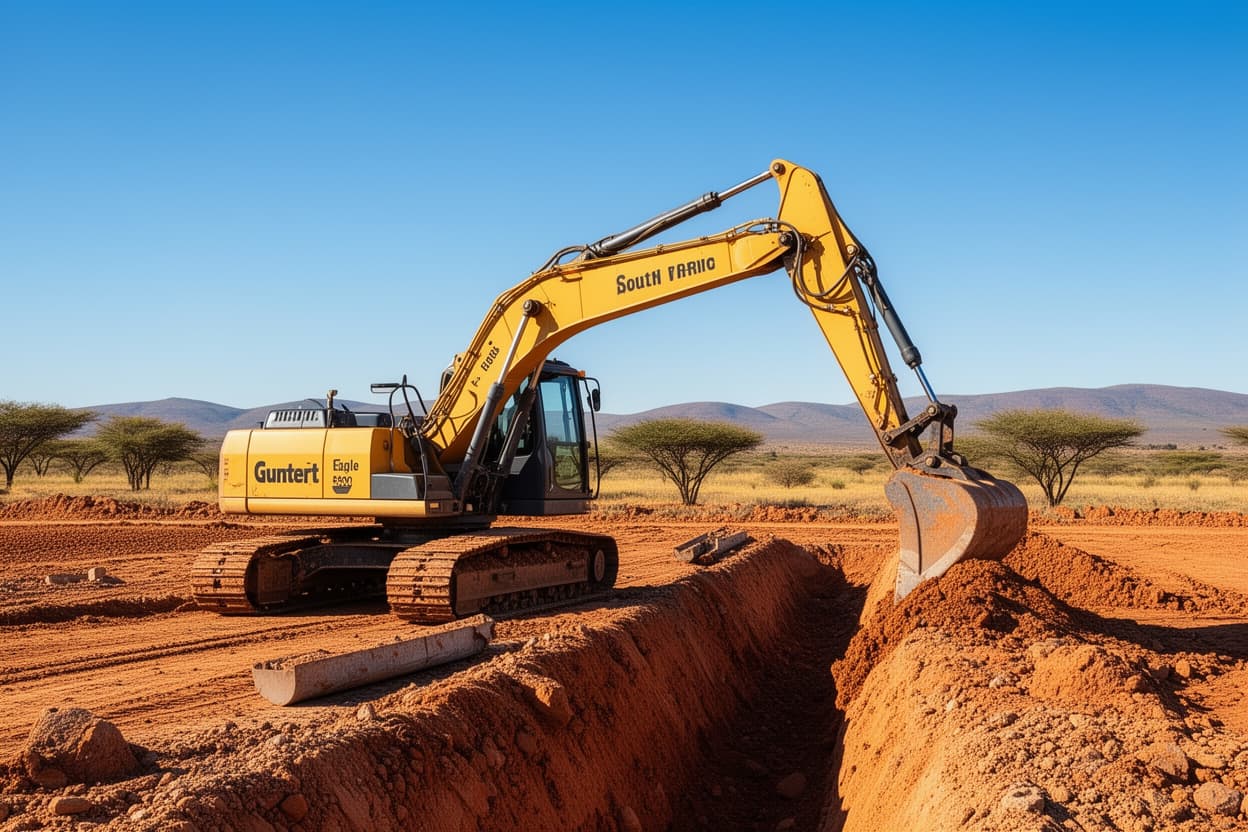
Guntert Eagle-8300 Excavator
The Guntert Eagle-8300 is a modern 9.3-ton hydraulic excavator designed for versatility and efficiency in South African construction and earthmoving applications. It offers a balance of power, precision, and operator comfort, making it suitable for a range of tasks from trenching to general site preparation.
Overview
The Guntert Eagle-8300 represents a new generation of mid-sized hydraulic excavators, specifically engineered to meet the demanding conditions of the South African market. With an operating weight of approximately 9.3 tonnes, it strikes an optimal balance between maneuverability on confined sites and sufficient power for challenging digging and lifting operations. This machine is positioned to be a reliable workhorse for contractors involved in civil engineering, infrastructure development, and general construction projects across the country.
Key design considerations for the Eagle-8300 include fuel efficiency, robust construction for longevity in harsh environments, and advanced hydraulic systems for precise control. Guntert aims to provide a machine that minimises downtime and maximises productivity, crucial factors for profitability in the competitive South African plant hire and construction sectors. The operator's environment has also received significant attention, with a focus on comfort and intuitive controls to reduce fatigue during long shifts.
- Engine Performance
- Equipped with a modern, emissions-compliant diesel engine, the Eagle-8300 delivers ample power for its class while maintaining good fuel economy. This is vital for managing operational costs in South Africa, where fuel prices can significantly impact project budgets.
- Hydraulic System
- The advanced hydraulic system ensures smooth, simultaneous operation of multiple functions, enhancing productivity. It allows for fine control, which is particularly beneficial for grading and precision work, and provides strong breakout force for tough digging conditions.
- Undercarriage Durability
- Designed for stability and durability, the undercarriage features robust components capable of withstanding rough terrain and prolonged use, common challenges on South African construction sites.
- Serviceability
- Ease of maintenance is a core feature, with accessible service points and simplified diagnostics to ensure quick turnaround times for routine checks and repairs, minimising costly idle periods.
Key specs
- Years produced
- 2025–2025
- Year range
- 2025
- Operating Weight
- 9,300 kg
- Engine Power
- 55-65 kW (74-87 hp) (est.)
- Bucket Capacity (Standard)
- 0.35 - 0.55 m³ (est.)
- Max Digging Depth
- 4.0 - 4.5 m (est.)
- Max Reach at Ground Level
- 6.5 - 7.0 m (est.)
- Tail Swing Radius
- 1.6 - 1.8 m (est.)
- Travel Speed (High)
- 4.5 - 5.5 km/h (est.)
- Hydraulic Pump Flow
- 120 - 150 L/min (est.)
- Fuel Tank Capacity
- 150 - 180 L (est.)
- Undercarriage Type
- Standard Tracked
- Cabin Type
- ROPS/FOPS Compliant
- Ground Pressure
- 0.35 - 0.45 kg/cm² (est.)
Specifications are estimated based on typical models in this class and may vary slightly depending on specific configurations and market releases for the Guntert Eagle-8300.
Applications
- General construction and site preparation
- Utility trenching and pipe laying
- Landscaping and earthmoving for residential/commercial projects
- Road construction and maintenance (smaller scale)
- Demolition of light structures
- Material handling and loading (with appropriate attachments)
Features
- Fuel-efficient, emissions-compliant diesel engine
- Advanced hydraulic system for precise control and multi-function operation
- ROPS/FOPS certified cabin for enhanced operator safety
- Ergonomic operator station with intuitive controls and air conditioning
- Robust undercarriage designed for durability in challenging terrain
- Easy access to service points for simplified maintenance
- Standard auxiliary hydraulic lines for various attachments
- High-visibility design for improved site awareness
Operating requirements
- Competent and certified excavator operator (e.g., SETA accredited)
- Regular pre-start checks and daily maintenance routines
- Adequate fuel supply (diesel) and hydraulic oil
- Suitable transport for machine relocation (low-bed trailer for 9.3-ton class)
- Clearance for tail swing and boom operation on site
- Access to Guntert-approved spare parts and technical support network in SA
- Compliance with local environmental and safety regulations
Attachments and options
Common attachments
- General purpose digging buckets (various sizes)
- Hydraulic breakers (hammers) for rock and concrete
- Trenching buckets (narrow)
- Grading/clean-up buckets (wide)
- Augers for drilling holes
- Quick couplers for rapid attachment changes
Options
- Additional auxiliary hydraulic lines for complex attachments
- Specialised undercarriage options (e.g., wider tracks)
- GPS/GNSS machine control systems for precision grading
- Heavy-duty guarding for forestry or demolition applications
- Biodegradable hydraulic oil options
- Extended warranty and service packages
Maintenance and inspections
- Daily visual inspection of fluid levels, hoses, and tracks
- Regular greasing of pivot points and pins
- Engine oil and filter changes as per manufacturer schedule (typically 250-500 hours)
- Hydraulic oil and filter changes at recommended intervals
- Fuel filter replacement to prevent contamination
- Track tension adjustment and inspection for wear
- Coolant level and quality checks
- Air filter cleaning/replacement
Adherence to the manufacturer's maintenance schedule is critical for machine longevity and warranty validity, especially given the demanding operating conditions often found in South Africa.
Safety notes
- ROPS/FOPS certified cabin to protect operator in rollovers or falling object incidents
- Seat belt interlock system to prevent operation without operator secured
- Emergency stop button easily accessible
- Rearview camera and mirrors for enhanced visibility
- Audible travel alarm for reversing operations
- Anti-slip surfaces on steps and platforms
- Hydraulic lock-out levers to prevent accidental movement
- Fire extinguisher readily available in the cabin
Buying checklist
- Verify Guntert's local dealer network and parts availability in your region of South Africa.
- Assess the specific application requirements to ensure the 9.3-ton class is appropriate.
- Compare fuel efficiency data against competitors for long-term operational cost savings.
- Inspect the cabin for operator comfort, visibility, and control layout.
- Enquire about standard and optional warranty packages available.
- Confirm the availability of financing options from Guntert or third-party providers.
- Check for any pre-delivery inspection reports and commissioning procedures.
- Understand the training programs offered for operators and maintenance staff.
- Review the total cost of ownership, including maintenance, parts, and resale value projections.
FAQ
What is the typical fuel consumption for the Guntert Eagle-8300?
While specific figures depend on application and operator technique, the Eagle-8300, being a modern machine, is designed for optimal fuel efficiency. Operators can expect consumption in the range of 8-12 litres per hour under typical mixed-duty cycles, but this is an estimate and can vary significantly. (est.)
Is the Guntert Eagle-8300 suitable for rock breaking in South Africa?
Yes, with the appropriate hydraulic breaker attachment, the Eagle-8300 has sufficient hydraulic power and stability for light to medium rock breaking tasks. For heavy-duty quarrying or large-scale rock excavation, a larger class excavator would be more suitable.
What kind of after-sales support can I expect for Guntert equipment in South Africa?
Guntert is establishing a growing presence in South Africa, aiming to provide comprehensive after-sales support including parts supply, field service technicians, and technical training. It's advisable to confirm the specifics with your local Guntert dealer regarding their service level agreements and parts stocking.
Can the Eagle-8300 be transported easily between sites?
At 9.3 tonnes, the Eagle-8300 falls into a category that typically requires a low-bed trailer for transport between sites. It is generally too heavy for standard tilt-bed trucks without specific permits and considerations for axle loads. Always check local road regulations for transport of heavy machinery.