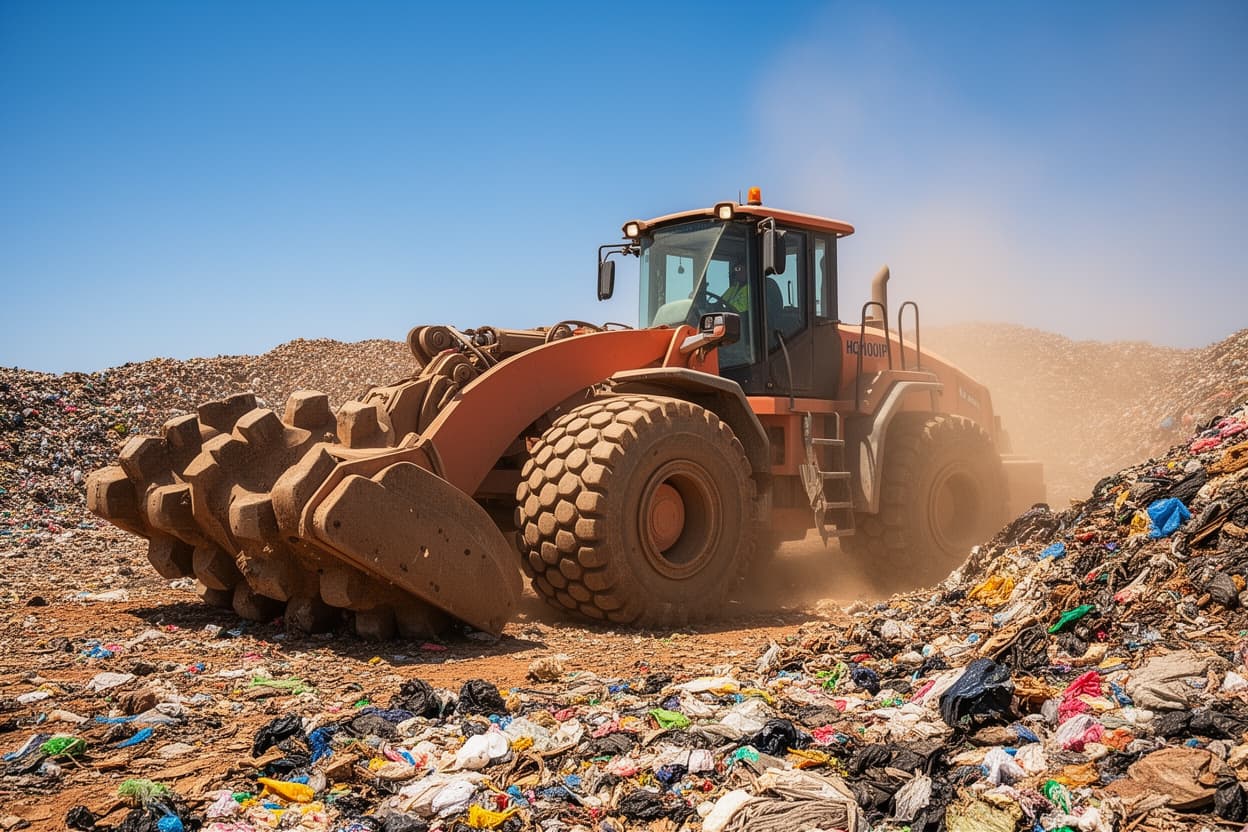
Hamm HC100IP Landfill Compactor
The Hamm HC100IP is a purpose-built landfill compactor designed for efficient and effective waste compaction in South African landfill operations. It features robust padfoot drums, powerful engine, and operator comfort, ensuring high productivity and durability in demanding environments.
Overview
The Hamm HC100IP landfill compactor is engineered to meet the rigorous demands of modern waste management facilities in South Africa. Its primary function is to achieve maximum compaction density of refuse, extending the lifespan of landfill cells and optimising airspace utilisation. This machine is not merely a soil compactor; it's specifically adapted for the unique challenges of landfill work, including handling diverse waste streams, operating on uneven terrain, and resisting abrasive and corrosive materials.
Key to its performance are the heavy-duty padfoot drums, which provide excellent traction and crushing force, breaking down waste and expelling air for superior compaction. The machine's robust chassis and drivetrain are designed for continuous operation in harsh conditions, a critical factor for South African landfill sites that often operate around the clock. Operator comfort and safety are also prioritised, with an ergonomic cabin providing good visibility and intuitive controls, reducing fatigue during long shifts.
For South African operators, the HC100IP represents a significant investment in efficiency and sustainability. Its ability to achieve high compaction rates directly translates to reduced operational costs and increased landfill capacity. Furthermore, Hamm's reputation for build quality and Wirtgen Group's support network in the region provide assurance regarding parts availability and technical service, crucial for minimising downtime in critical waste management operations.
- Optimised Compaction
- Specifically designed padfoot drums and high static linear load ensure maximum waste density.
- Robust Construction
- Heavy-duty components and sealed systems protect against harsh landfill environments.
- Operator Comfort
- Ergonomic cabin with climate control and excellent visibility enhances productivity and safety.
- Serviceability
- Easy access to service points simplifies routine maintenance, reducing downtime.
Key specs
- Years produced
- 2025–2025
- Year range
- 2025
- Operating Weight
- Approx. 12,462 kg
- Engine Power
- Approx. 100-120 kW (134-161 hp) (est.)
- Drum Type
- Padfoot (front and rear)
- Drum Width
- Approx. 2130 mm (est.)
- Number of Drums
- 2
- Compaction Force (Centrifugal)
- Not applicable (static compaction)
- Travel Speed (Max)
- Approx. 10-12 km/h (est.)
- Gradeability
- Up to 45-50% (est.)
- Fuel Tank Capacity
- Approx. 250-300 litres (est.)
- Articulation Angle
- Approx. +/- 35 degrees (est.)
- Oscillation Angle
- Approx. +/- 10 degrees (est.)
- Turning Radius (Inner)
- Approx. 3.5-4.0 m (est.)
Specifications are typical for this class of landfill compactor and may vary slightly based on specific configurations or regional models. Exact figures should be confirmed with the manufacturer or dealer.
Applications
- Municipal Solid Waste (MSW) Landfills
- Industrial Waste Landfills
- Transfer Stations (for pre-compaction)
- Waste Recycling Facilities (for material handling and compaction)
- Site preparation and compaction of cover material
Features
- Heavy-duty padfoot drums for aggressive waste breakdown and compaction
- Hydrostatic drive system for smooth power delivery and excellent traction
- Articulated steering for high manoeuvrability on uneven terrain
- Oscillating rear axle for consistent ground contact and stability
- Spacious, air-conditioned ROPS/FOPS cabin with ergonomic controls
- Excellent all-round visibility for enhanced safety and operational awareness
- Integrated trash deflectors and drum scrapers to prevent material build-up
- Centralised lubrication points for simplified maintenance
- Engine designed for fuel efficiency and reduced emissions
Operating requirements
- Skilled operators trained in landfill compaction techniques and safety protocols
- Regular cleaning of drums, chassis, and cooling systems due to dusty/dirty environment
- Adequate fuel supply (diesel) and on-site maintenance facilities
- Access to Hamm/Wirtgen Group authorised service and genuine spare parts in South Africa
- Compliance with local environmental regulations for emissions and waste management
- Robust tyre/drum maintenance program to handle abrasive waste materials
- Effective communication systems for coordination on large landfill sites
Attachments and options
Common attachments
- Dozer blade (front-mounted) for spreading and pushing waste
- Additional lighting packages for night operations
- Specialised drum cleaning systems (e.g., hydraulic scrapers)
- Rear-view cameras and proximity sensors for enhanced safety
Options
- Cold start package for extreme weather conditions
- Biodegradable hydraulic oil
- Telematics system for remote monitoring and diagnostics (e.g., Hammtronic)
- Custom paint schemes or branding
- Fire suppression system for increased safety in combustible environments
Maintenance and inspections
- Daily visual inspection of drums, scrapers, and hydraulic lines
- Regular cleaning of radiator and engine compartment to prevent overheating
- Scheduled oil and filter changes for engine, hydraulics, and transmission
- Greasing of articulation points and other moving components
- Inspection and adjustment of drum scrapers and trash deflectors
- Checking and maintaining tyre pressure (if applicable to specific models/configurations)
- Monitoring of onboard diagnostic systems for fault codes
Due to the harsh operating conditions in landfills, preventative maintenance is paramount to ensure longevity and minimise unexpected downtime. Adherence to Hamm's recommended service intervals is critical.
Safety notes
- ROPS/FOPS certified cabin for operator protection
- Emergency stop buttons (internal and external)
- Seatbelt interlock system
- Audible reverse alarm and flashing beacon
- Excellent visibility from the operator's station, often supplemented with mirrors and cameras
- Handrails and anti-slip surfaces for safe access and egress
- Fire extinguisher mounting points
- Lockable battery disconnect switch
Buying checklist
- Verify the machine's service history and maintenance records (if used)
- Inspect the condition of the padfoot drums for excessive wear or damage
- Check for leaks in hydraulic systems, engine, and transmission
- Assess the cabin for comfort, functionality of controls, and air conditioning
- Confirm availability of genuine Hamm spare parts and local dealer support in your region of South Africa
- Evaluate the machine's suitability for your specific landfill size and waste stream characteristics
- Obtain a detailed quote including delivery, warranty, and service agreements
- Consider financing options and total cost of ownership (TCO) over the machine's lifespan
- Review the machine's telematics capabilities for fleet management and operational insights
FAQ
What makes the Hamm HC100IP suitable for South African landfills?
Its robust construction, powerful compaction capabilities, and design features like trash deflectors are specifically engineered for the demanding and often abrasive conditions found in South African landfill sites. The Wirtgen Group's local support network also ensures parts and service availability.
Can the HC100IP handle different types of waste?
Yes, the padfoot drums are highly effective at breaking down and compacting a wide range of municipal and industrial waste, including bulky items, by crushing and kneading the material to achieve high densities.
What is the typical lifespan of a landfill compactor like the HC100IP?
With proper maintenance and operation, a Hamm HC100IP can have a service life exceeding 10,000 to 15,000 operating hours, often more. Regular servicing and timely repairs are crucial for maximising its lifespan in the harsh landfill environment.
Is a dozer blade a standard feature or an option?
While some compactors may have integrated blades, for the Hamm HC100IP, a front-mounted dozer blade is typically an optional attachment. It significantly enhances the machine's versatility by allowing it to spread and push waste in addition to compacting.